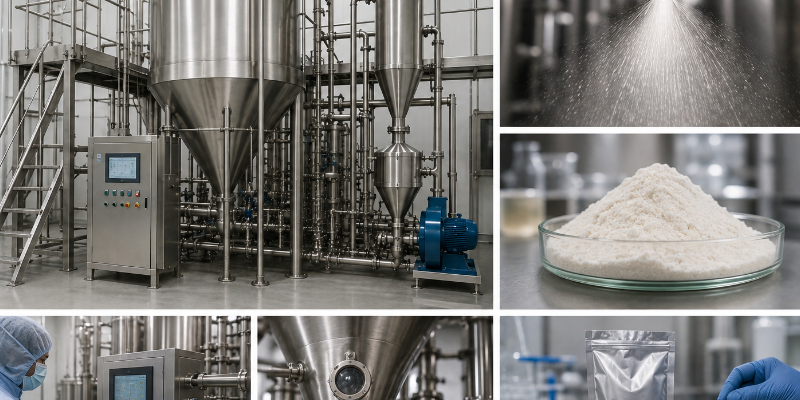
How to Choose a Contract Spray Drying Partner in India: 12 Questions to Ask
In Summary
Choosing the right contract spray drying partner in India is an important step when developing a new powder product or scaling an existing formulation. The right partner should offer more than processing equipment. Technical expertise, feasibility assessment, pilot trials, process development, quality controls and commercial-scale capability can all influence the success of a project.
Before selecting a contract spray drying company, here are 12 important questions to ask.
\r\n\r\n1. Can they conduct a feasibility trial?
\r\n\r\nA feasibility trial is often the best starting point for a new spray drying project. Ask whether the partner can evaluate your feed material and determine whether it is technically suitable for spray drying.
\r\n\r\nA well-planned trial can provide useful information about powder formation, moisture, recovery, particle characteristics and other product requirements before commercial production.
\r\n\r\n2. Do they have both pilot and commercial-scale capabilities?
\r\n\r\nA spray drying partner should ideally be able to support the complete development journey. Moving directly from laboratory development to commercial production can introduce scale-up challenges.
\r\n\r\nAsk about available pilot equipment, commercial processing capacity and how process parameters are transferred from development trials to larger batches.
\r\n\r\n3. What types of feed materials can they process?
\r\n\r\nSpray drying can be used for different types of liquid feeds, including solutions, suspensions, emulsions and suitable slurries.
\r\n\r\nBefore starting a project, provide information such as total solids, viscosity, feed composition, water or solvent base, thermal sensitivity and known stability concerns. This allows the technical team to assess process suitability more effectively.
\r\n\r\n4. How do they approach particle-size requirements?
\r\n\r\nParticle size can affect powder flow, dissolution, dispersibility, bulk density and downstream processing.
\r\n\r\nAsk how the manufacturer approaches your target particle-size specification and which process variables can be adjusted to achieve the required powder characteristics. The appropriate approach will depend on the feed properties and intended application.
\r\n\r\n5. How is product quality evaluated?
\r\n\r\nUnderstand which quality parameters are evaluated during trials and commercial batches. Depending on the product, these may include moisture, particle-size distribution, bulk density, appearance, solubility, flowability and other customer-specific specifications.
\r\n\r\nIt is also useful to establish which tests are performed internally and which may require external analytical support.
\r\n\r\n6. How is cross-contamination controlled?
\r\n\r\nFor pharmaceutical, nutraceutical, food and specialty ingredients, cleaning and changeover practices are important considerations.
\r\n\r\nAsk about equipment cleaning, product changeover, material segregation and the procedures followed to minimize the risk of cross-contamination between products.
\r\n\r\n7. What documentation can they provide?
\r\n\r\nDepending on the application, customers may require batch records, specifications, certificates of analysis, test results, process information or other manufacturing documentation.
\r\n\r\nDiscuss documentation requirements before beginning a trial so that both parties have a clear understanding of what will be provided.
\r\n\r\n8. Can they support process development and optimization?
\r\n\r\nA capable contract spray drying partner should contribute technical knowledge rather than simply process material according to a fixed set of instructions.
\r\n\r\nDuring development, parameters such as feed concentration, feed rate, atomization conditions, inlet and outlet temperatures and other operating conditions may need to be evaluated and optimized to achieve the desired powder characteristics.
\r\n\r\n9. Can they handle your expected commercial volume?
\r\n\r\nPilot capability does not automatically mean that a supplier has sufficient commercial capacity.
\r\n\r\nDiscuss your expected production volume, batch size, production frequency and future scale-up requirements. Understanding commercial capacity early can help avoid changing suppliers when demand increases.
\r\n\r\n10. Do they maintain transparency throughout the project?
\r\n\r\nTransparency is an important part of successful contract manufacturing. A partner who openly communicates trial observations, process challenges, limitations and results allows both teams to understand the product and process better.
\r\n\r\nTransparent communication during feasibility trials and process development also creates opportunities to learn from the results, identify areas for improvement and optimize the process together. This can be especially valuable when working with a new formulation or an unfamiliar feed material.
\r\n\r\n11. Can they protect confidential information and intellectual property?
\r\n\r\nMany spray drying projects involve proprietary formulations, new product concepts or confidential process information.
\r\n\r\nBefore sharing detailed technical information, establish appropriate confidentiality arrangements and clarify how formulation information, process knowledge and development results will be handled.
\r\n\r\n12. Can they support the project from trial to commercial production?
\r\n\r\nA long-term contract manufacturing relationship can be more valuable when the same technical partner can support the complete project journey.
\r\n\r\nIdeally, the partner should be able to assist with initial feasibility assessment, pilot trials, process development, optimization, scale-up and commercial manufacturing.
\r\n\r\nChoosing the Right Contract Spray Drying Partner
\r\n\r\nSelecting a contract spray drying partner should not be based only on equipment size or processing cost. Technical expertise, pilot capability, commercial capacity, quality controls, documentation, transparency, confidentiality and scale-up support should all be considered.
\r\n\r\nAt Delta Formulations, companies can discuss their product requirements, feed characteristics, target powder specifications and expected production volumes for an initial feasibility assessment. The objective is to understand the processing requirements, learn from feasibility results and develop a suitable path toward commercial production.
\r\n\r\nIf you are evaluating contract spray drying or spray drying job work in India, sharing your available product and process information at the beginning can help the technical team assess feasibility efficiently and define the next steps