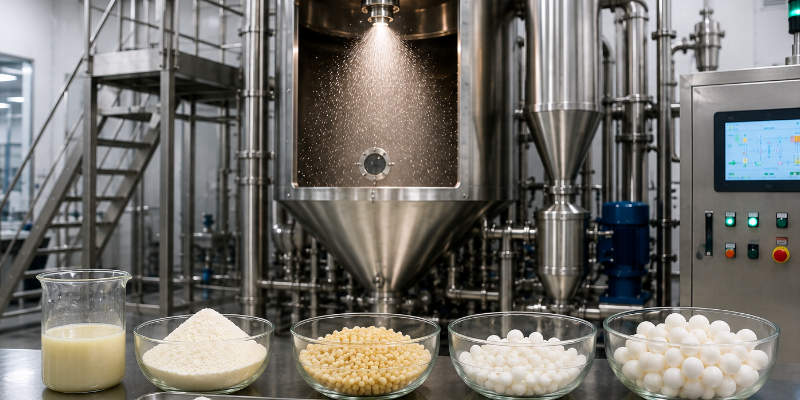
Spray Congealing Particle Size Control for Microspheres and Granules
In Summary
Particle size is one of the most important characteristics when developing products through spray congealing. The size and morphology of the resulting particles can influence flowability, handling, dosing, dispersion, dissolution and downstream processing. For companies developing wax, lipid, fatty-acid or other melt-based particulate products, understanding how particle size is controlled during spray congealing can help establish realistic product specifications and processing conditions.
What Is Spray Congealing?
\r\n\r\nSpray congealing converts a molten material into solid particles by atomizing the melt into a controlled cooling environment. As the droplets lose heat, they solidify and form particles. Unlike spray drying, the process does not depend on evaporating water or another solvent from the droplets.
\r\n\r\nThe final particle characteristics depend on both the properties of the molten feed and the conditions used during atomization and cooling.
\r\n\r\nWhat Controls Particle Size?
\r\n\r\nSeveral factors can influence the particle size produced during spray congealing.
\r\n\r\nMelt viscosity is an important consideration. A material with different viscosity characteristics may produce a different droplet size during atomization. Maintaining suitable and consistent melt conditions can therefore be important for achieving repeatable particles.
\r\n\r\nAtomization conditions also have a direct influence on droplet formation. The atomization method, operating conditions and equipment configuration can affect the size distribution of the droplets before they solidify.
\r\n\r\nFeed temperature can influence melt viscosity and flow behaviour. Maintaining the appropriate temperature range for the material can help provide more consistent processing conditions.
\r\n\r\nCooling conditions determine how quickly the atomized droplets solidify. Cooling conditions need to be considered together with the material's melting and solidification behaviour.
\r\n\r\nMicrospheres, Granules and Free-Flowing Particles
\r\n\r\nDepending on the material and process conditions, spray congealing can be evaluated for producing different particulate forms, including microspheres, beads and granules. The required particle-size range should be defined according to the intended application rather than simply selecting the smallest possible particle size.
\r\n\r\nFor some applications, a narrower particle-size distribution may be desirable, while other applications may require a specific broader range. Particle morphology and flow characteristics can also be important alongside particle size.
\r\n\r\nFrom Feasibility Trial to Scale-Up
\r\n\r\nParticle-size development is best approached through controlled feasibility and pilot trials. The technical team can evaluate the material properties, target particle size and intended application before determining suitable processing conditions.
\r\n\r\nOnce an acceptable particle profile is established at pilot scale, the process can be further optimized for commercial production. Consistent control of feed properties and operating conditions becomes increasingly important during scale-up.
\r\n\r\nChoosing a Spray Congealing Partner
\r\n\r\nCompanies developing microspheres, granules or other melt-based particles should select a processing partner with the ability to evaluate material properties, conduct feasibility trials and support process development and scale-up.
\r\n\r\nDelta Formulations supports spray congealing and spray cooling applications for suitable waxes, fatty materials and other melt-processable ingredients. Companies can share their material properties, target particle-size range, desired morphology and expected production volume for an initial technical feasibility discussion.